The Chinese Currency (RMB / Yuan): History, Value, and Global Role
Quick Summary
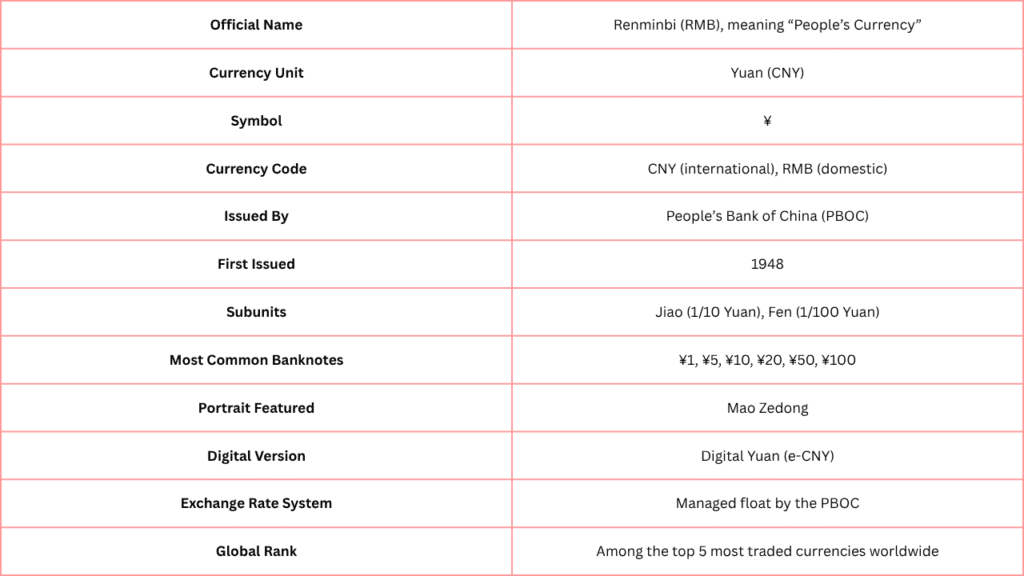
The Renminbi (RMB), also called the Yuan (CNY), is the official currency of China, issued by the People’s Bank of China since 1948. Its name means “People’s Currency,” and it plays a major role in both China’s domestic economy and global trade.
In recent years, the RMB has become one of the world’s most traded currencies, reflecting China’s rise as an economic superpower.
Introduction: What Is the Chinese Currency (RMB)?
The Renminbi (RMB), often referred to as the Chinese Yuan (CNY), is the official currency of the People’s Republic of China. Its name literally means “People’s Currency.” The basic unit of the RMB is the yuan, and its symbol is ¥ — the same symbol used for the Japanese yen.
Today, the RMB is not only central to China’s domestic economy, but also plays an increasingly important role in global trade and finance, especially as China expands its influence through the Belt and Road Initiative.
History of the Renminbi
The Renminbi was first issued in 1948 by the People’s Bank of China (PBOC), just before the founding of the People’s Republic of China. It replaced various regional currencies that circulated during the Republican era and the Chinese Civil War.
Over the decades, the RMB has gone through multiple redesigns and reforms:
1950s–70s: Controlled and limited convertibility under Mao’s centrally planned economy.
1980s–90s: Gradual reform and modernization during Deng Xiaoping’s economic opening.
2005 onwards: Partial liberalization of the exchange rate and greater international use.
RMB vs. Yuan: What’s the Difference?
While “Renminbi” and “Yuan” are often used interchangeably, there’s a subtle difference:
Renminbi (RMB) is the official name of China’s currency system.
Yuan (CNY) refers to the unit of account, similar to how “pound sterling” and “pound” work in the UK.
So, prices in China are quoted in yuan, while international markets use RMB to refer to the currency in general.
Exchange Rate and Global Use
The RMB’s value is managed by the Chinese government, meaning it’s not a fully free-floating currency like the US dollar or the euro. The People’s Bank of China sets a daily reference rate, allowing limited fluctuations within a narrow band.
As China’s economy grew, the RMB gained international importance:
In 2016, it was added to the IMF’s Special Drawing Rights (SDR) basket, alongside the USD, EUR, GBP, and JPY.
Many countries now hold RMB in their foreign exchange reserves.
The RMB is increasingly used in cross-border trade settlements and international investment.
Design and Symbols
Modern RMB banknotes feature prominent images of Chairman Mao Zedong, reflecting his enduring historical significance. The notes are issued in denominations of 1, 5, 10, 20, 50, and 100 yuan, while coins represent smaller units called jiao and fen.
The currency code is CNY, though RMB is commonly used in international contexts.
Digital Yuan (e-CNY): The Future of China’s Currency
China is pioneering one of the world’s first central bank digital currencies (CBDCs) — the digital yuan, or e-CNY.
It aims to make payments more efficient, reduce cash use, and strengthen China’s control over its financial system.
The digital yuan is already being tested in cities like Shenzhen, Suzhou, and Beijing, and may eventually become part of the global digital economy.
RMB in Global Trade and Investment
The RMB is now one of the top five most traded currencies in the world. It’s heavily used in trade between China and Asia, Africa, and Latin America — especially under the Belt and Road Initiative.
China’s efforts to internationalize the RMB aim to make it a credible alternative to the US dollar over time.
Conclusion
The Chinese currency — the Renminbi (RMB) — is more than just money; it’s a symbol of China’s economic transformation and growing global power.
From its origins in 1948 to today’s experiments with the digital yuan, the RMB reflects China’s journey from isolation to global influence.